Contents
The family lines
The book follows Dorothy Russell’s four grandparent lines, Russell, Pines, Cuffel and Cagley, and the many streams that ran into them.
“Its sources are dozens of small streams, each one a single life.”
The book starts near the end, in the valley in 1943. Then it goes back to the headwaters and follows the streams down until they meet. The bars below place each part on the timeline, in reading order.
Russell and Cuffel lines Each chapter carries the book’s family-line mark. Its four ends stand for the Russell, Pines, Cuffel and Cagley lines; the lines a chapter follows are drawn in colour.
Opening
Confluence
A short introduction: why the book pictures a family as a river, its streams finding one another over the generations.
Part One, 1943–1950
The valley
Enterprise, Alder Slope and Wallowa Lake in the 1940s, where three of the Russell siblings came to make their homes.
- Chapter 1Arrival in the Wallowa countryAll four lines
Part Two, 1634–1805
The headwaters
The oldest sources: New England from the 1630s, the German-speaking villages of the Rhine, and the Renners and Koffels in Pennsylvania.
- Crossing, 1635The Stiles party aboard the ChristianCuffel line
- Chapter 2Founding households of New EnglandCuffel line
- Chapter 3Leaving the RhineCuffel and Cagley lines
- Crossing, 1732The Renners aboard the JohnsonCuffel line
- Chapter 4The Renners and Koffels in PennsylvaniaCuffel line
Part Three, 1764–1783
The Wagon Road and the war
South from Pennsylvania to the Virginia frontier, an indenture at Philadelphia, and the war years in Bucks County, Deerfield, the Virginia frontier and Kent.
- Chapter 5South on the Wagon RoadCagley line
- Crossing, 1772The Ribbles bound at PhiladelphiaCagley line
- Chapter 6Households in the RevolutionRussell, Cuffel and Cagley lines
Part Four, 1772–1856
The backcountry and the Old Northwest
The Wythe County households after the war, and the roads west through New York, Ohio and Indiana.
- Chapter 7The clock and the doctor’s householdCagley line
- Chapter 8Reed Creek and the family farmCagley line
- Chapter 9From Deerfield to the GeneseeCuffel line
- Chapter 10The Koffels and Halpruners in OhioCuffel line
- Chapter 11The Wabash countryCuffel and Cagley lines
Part Five, 1845–1890
Where the streams met
Albert and Rebecca, the Civil War, the English Russells and their crossing, and Iowa, where the families came together.
- Chapter 12Albert and RebeccaCuffel line
- Chapter 13Households in the Civil WarRussell, Pines and Cuffel lines
- Chapter 14The Russells in Kent and LondonRussell and Pines lines
- Crossing, 1868The Russells crossing the AtlanticRussell and Pines lines
- Chapter 15The families come together in IowaAll four lines
Part Six, 1889–1906
The Plains
William John and Bertha’s search for land: north Texas, the Oklahoma claim, Minnesota and the train west.
- Chapter 16William Russell and his kinAll four lines
Part Seven, 1906–1946
Four Mound and the siblings
How the eight Russell children grew up on a Washington farm, then made homes across the West through the Depression and the war.
- Chapter 17The children of Four MoundAll four lines
- Chapter 18The homes they madeAll four lines
Part Eight, 1950–2021
Full circle
The siblings in later life, the keepers of the family’s story, and a return to the valley.
- Chapter 19The valley againAll four lines
Where the streams meet
How the book numbers ancestors
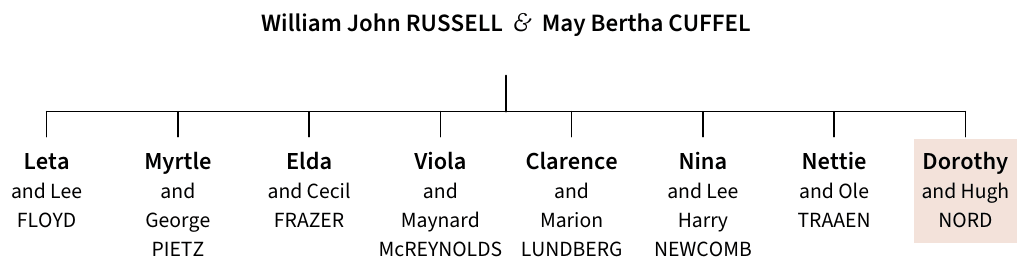
Every ancestor in these charts carries a number. Dorothy is 1. A person’s father is twice their number and their mother is twice their number plus one, so Dorothy’s father, William John Russell, is 2 and her mother, Bertha, is 3. The numbers stay the same on every chart.
The family tree online
The research tree behind the book is on Ancestry, kept by crenbrinordell: ancestry.com/family-tree/tree/25307423 Not live yet
Ancestry shows other members’ trees only to subscribers, or to people the tree’s owner invites. If you would like an invitation, email confluence@ochremoon.com; you will need a free Ancestry account. Living people are hidden on the tree. The charts in the book are free for everyone.